
Backup Power for Industrial Facilities — Diesel Generators, UPS, Hybrid
Backup power for business from LK Energy Group: diesel generators, UPS units, battery energy storage systems (BESS) and hybrid solutions — from an office to an industrial site of 1+ MW. Full-cycle EPC: calculation, design, installation and commissioning, all in-house, since 2005. We design the configuration to match your load and its criticality. Submit a request and we'll size backup power for your site.
Backup Power for Business — BESS, Diesel, Hybrid Systems
Blackouts, grid instability and the risk of disconnections have turned backup power from an optional investment into a business necessity. ATM goes down — customers leave. Server crashes — data is lost. Refrigeration fails — a tonne of product is ruined. LK Energy designs and installs hybrid systems based on BESS, diesel generator sets (DGS) and ATS (automatic transfer switches) — from a 5 kW office to an industrial facility of 1+ MW. A load-specific calculation is typically delivered within 24 hours on business days.
Why Backup Power Has Become a Business Essential
In an environment of unreliable power supply and the risk of both scheduled and emergency outages, uninterruptible power has become critical for any business where downtime translates directly into financial loss.
Business consequences of outages:
- Direct losses — spoiled product (food, pharmaceuticals), lost transactions (banking, e-commerce), interrupted production processes
- Indirect losses — customer attrition due to service downtime, reputational risks, contract loss through SLA breach
- Digital disaster — server room without UPS = corrupted databases, lost sessions, damaged file systems
Important: The risks of outages and their impact on a specific facility are individual. LK Energy does not guarantee a specific uptime percentage — actual autonomy depends on the chosen configuration, maintenance schedules and fuel quality for the diesel component of the system.
Who Needs Backup Power (Typical Clients)
| Segment | Why it is critical | Indicative budget* |
|---|---|---|
| Corporate offices / Business centres | Workflow continuity, IP telephony, server room | $5K — $50K |
| Banks + ATMs | NBU continuity requirements, cash flow operations | $15K — $200K |
| Data centres (Tier III/IV) | Uptime SLA 99.9%+, redundancy N+1 / 2N | $100K — $1M+ |
| Hospitals and medical centres | DBN V.2.2-10:2022, Category I reliability under PUE for critical consumers | $50K — $500K |
| Food industry enterprises | Cold storage chambers, production cycle | $30K — $300K |
| Fuel stations / CNG stations | Fuelling transactions, safety, business continuity | $10K — $80K |
| Retail / Shopping centres | POS systems, lighting, refrigeration equipment, pump stations | $15K — $150K |
| Food service establishments | Kitchen (ranges, ovens), refrigerators, POS | $5K — $30K |
| Server rooms / Telecom nodes | Critical infrastructure, UPS + generator mandatory | $20K — $200K |
| Security systems (cameras / access control) | Monitoring continuity, security | $3K — $20K |
*Budgets are indicative, VAT excluded, and are calculated individually following a load audit.
Solution Architecture — 4 Typical Configurations
Configuration 1: Diesel DGS + ATS (classic, lowest cost)
Configuration:
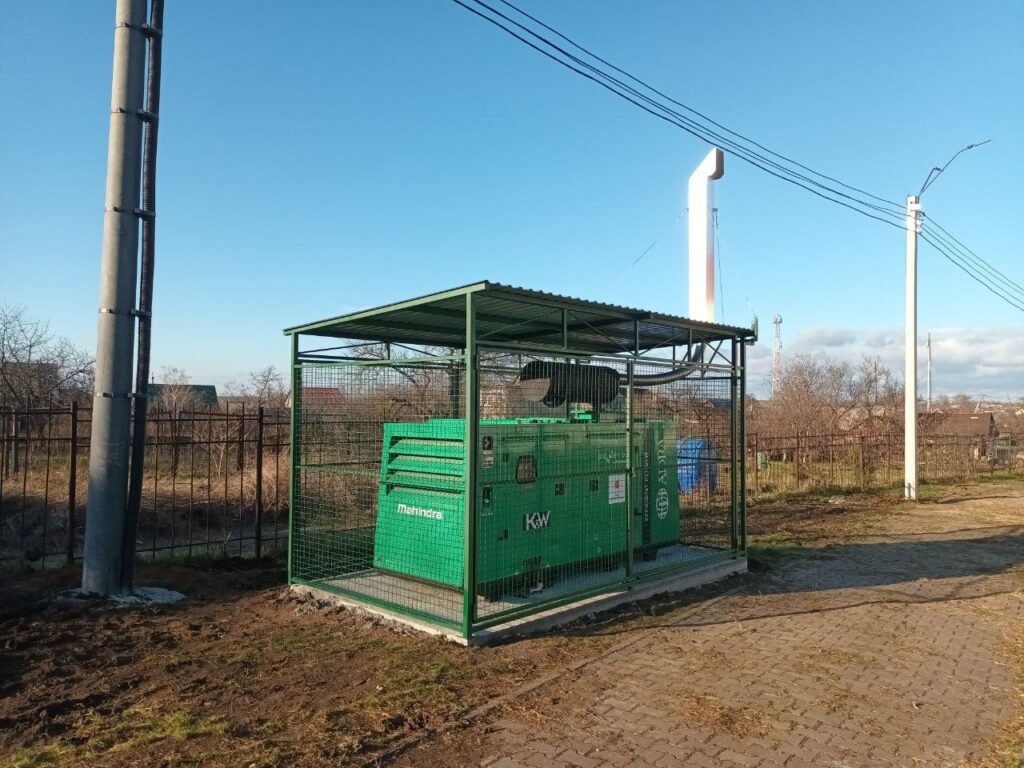
- Diesel generator set (10–1000 kW)
- Automatic transfer switch (ATS)
- Fuel system (tank, fuel distribution unit)
Transfer time: 5–15 seconds
Suited for: non-critical loads where a brief interruption of a few seconds is acceptable (warehouses, production with restart-friendly processes)
Budget: lowest (from $5K for a small installation)
Drawbacks:
- Brief power interruption → reboots of PCs, servers, server equipment
- Noise, vibration, exhaust gases — requires separate siting or a sound-attenuating enclosure
- Regular maintenance required, periodic refuelling
Configuration 2: UPS + Diesel DGS + ATS (standard for banks, offices)
Configuration:
- UPS (online double-conversion) for critical loads
- Full-capacity diesel generator set
- ATS switching between generator and mains
Transfer time: ≈0 seconds (online UPS bridges the gap with no interruption)
Suited for: offices, banks, pharmacies, server rooms up to Tier II
Budget: $15K — $80K (depending on UPS capacity)
Drawbacks:
- UPS batteries — service item every 3–5 years (replacement $1–3K)
- Two systems = two maintenance contracts
Configuration 3: BESS + ATS (silent, fuel-free)
Configuration:
- BESS (Battery Energy Storage System) — Li-ion / LiFePO4
- Hybrid inverter-charger
- ATS switching
Transfer time: ≈0 seconds (BESS in online mode operates as a UPS)
Autonomy: 2–12 hours (depending on BESS capacity and load)
Suited for: offices, retail, telecom nodes, non-banking critical facilities
Budget: $20K — $200K
Drawbacks:
- Limited autonomy compared to diesel (fuel can be added, batteries cannot)
- Higher capital expenditure than a conventional diesel generator
- LiFePO4 battery degradation ~1–3% per year (typical)
Configuration 4: BESS + Diesel DGS + ATS (Tier III hybrid, most reliable)
Configuration:
- BESS providing 1–4 hours of autonomy
- Full-capacity diesel generator set for extended outages
- Smart controller: BESS covers short outages, diesel starts only for prolonged ones
- Multi-stage ATS (mains → BESS → DG)
Transfer time: ≈0 seconds
Autonomy: theoretically unlimited (while fuel is available)
Suited for: data centres, banking, hospitals, mega-retail, telecom critical hubs
Budget: $100K — $1M+
Advantages: lowest total cost over the long term — fewer diesel running hours, reduced wear, lower fuel consumption
Drawbacks: highest CAPEX
*Prices are indicative, VAT excluded; exact cost is calculated individually based on the technical specification, load type and chosen equipment brand.
How to Choose a Configuration — Practical Guide
Step 1: Load audit
- Measure actual consumption (wattmeter, power quality analyser)
- Identify critical vs non-critical loads (for example: server room — critical; office air conditioning — non-critical)
- Calculate peak start-up demand (motors on direct-on-line start have an inrush current of 5–8× the rated value)
Step 2: Determine required autonomy
- What is the acceptable duration of a complete power outage?
- Office hours: typically 8–12 hours
- 24/7 services (banks, hospitals): 24+ hours of autonomy
Step 3: CAPEX vs OPEX
- Diesel: lower CAPEX, higher OPEX (fuel, maintenance)
- BESS: higher CAPEX, lower OPEX (electricity for charging only)
- Hybrid: optimal TCO over 5–10 years
Step 4: Space and noise
- Diesel requires a separate ventilated room or an external enclosure
- BESS is compact and can be installed in a technical room (LiFePO4 is more thermally stable than Li-NMC)
BESS — Key Selection Criteria
Battery chemistry:
- LiFePO4 (Lithium Iron Phosphate) — recommended for buildings: thermally stable, resistant to thermal runaway, 6000+ cycles
- Li-NMC (Nickel Manganese Cobalt) — more compact, but requires thermal management
- Pb-acid (lead-acid) — recommended for UPS applications only, not for BESS resilience
Key parameters when selecting:
- Depth of discharge (DoD) — must be ≥80% (LiFePO4 operational DoD up to 90%)
- C-rate — ability to deliver/receive power (1C = full cycle in 1 hour)
- Manufacturer warranty — typically up to 10 years or 6000 cycles
- BMS (Battery Management System) — mandatory with protection against overheat / overcharge / undercharge
- Certification — UL 9540 / UL 9540A, IEC 62619, VDE 2510-50
Diesel Generator Sets — Selection
Generator classes (per ISO 8528-1):
- Standby — for blackout backup, limited annual operating hours, no overload
- Prime — for regular use, with permissible overload
- Continuous — 24/7 without restriction, rarely used in commercial applications
Manufacturers represented in Ukraine: Cummins, Caterpillar, Perkins, FG Wilson, Volvo Penta and other leading brands, as well as Ukrainian manufacturers. The specific model is selected to match the facility’s power requirements and operating mode.
Key parameters:
- Output — kVA / kW (P = S × cos φ)
- Start type — electric starter from battery (24V predominantly)
- Cooling type — air-cooled (up to 30 kW), liquid-cooled (above)
- Emission standards — Stage IIIA / Stage V (European standards)
- Noise — ≤75 dB at 1 m for sound-attenuated enclosure
ATS — Automatic Transfer Switches
The ATS (Automatic Transfer Switch) is the heart of any backup power system. Selection depends on:
- Capacity (A, kVA)
- Transfer time (ms for UPS-grade, 5–15 s for conventional)
- Type: open transition (brief interruption) vs closed transition (synchronised, break-free — for critical facilities)
We use ATS equipment from leading manufacturers (ABB, Schneider Electric, Eaton, Socomec, Siemens, etc.) — the model is selected to match the facility’s capacity and class.
Special Considerations for Healthcare Facilities
Healthcare facilities require Category I power supply reliability under PUE for critical consumers — operating theatres, intensive care units, maternity wards. This mandates a backup source with an automatic transfer switch in accordance with DBN V.2.2-10:2022 and PUE; for the special group of Category I — an independent third source with minimal power interruption.
Critical loads (backed up 100%):
- Operating theatres
- Intensive care units
- Laboratories with continuous-operation equipment
- Server room, medical databases
- Medical gas supply systems (oxygen, medical gases)
- Emergency evacuation lighting systems
Recommended configuration: Configuration 4 (BESS + Diesel DGS + ATS) with the BESS section covering critical loads + full-capacity diesel generator.
Warranty, Insurance, Maintenance
Warranties from LK Energy:
- Installation: per contract terms
- BESS: typically up to 10 years / 6000 cycles (passed on from manufacturer)
- DG: 24–60 months (depending on brand)
Construction and installation insurance — upon client request, we arrange insurance for construction and installation risks in accordance with the contract terms (including for critical facilities such as banks and hospitals).
Scheduled maintenance — recommended:
- DG: quarterly inspection, annual full diagnostic, oil change every 250 operating hours
- BESS: semi-annual BMS inspection, annual capacity test
- ATS: annual transfer test
*Exact warranties and maintenance terms are specified in a separate service agreement.
Frequently Asked Questions
1. How much does backup power for an office cost? Depending on capacity and type — indicatively from $5K (small office on diesel) to $80K (BESS+DG for a bank).* A facility-specific calculation within 24 hours on business days.
*Indicative figures, VAT excluded, calculated individually.
2. Is a permit required for installing a diesel generator set? Yes, a permit from the local authority is required — particularly where installation involves noise impact on neighbours. LK Energy assists with the permitting process.
3. How long does BESS run on a single charge? This depends on BESS capacity and load. Typically 2–12 hours for an office configuration.
4. Can BESS fully replace a diesel generator? For short blackouts (≤4 hours) — yes. For prolonged outages (10+ hours) — a BESS+DG hybrid is the optimal solution.
5. What is the service life of LiFePO4 batteries? 6000+ cycles (approximately 15–20 years at 1 cycle per day), manufacturer warranty typically up to 10 years.
6. Can a solar PV system be integrated with a backup power system? Yes — this is an Off-Grid / On-Grid hybrid. Hybrid inverter + BESS + DG = full energy independence.
7. How quickly can you install the system? Depending on the equipment: small systems 3–5 days, large systems (>200 kW) — 4–8 weeks from order (including supply).
8. Are BESS systems safe in the event of a fire? LiFePO4 is significantly more resistant to thermal runaway than Li-NMC, due to its chemistry and higher temperature threshold. Additional protection is provided by BMS monitoring + IP65 enclosure for outdoor installations.
9. Is a separate cable feed required? Typically yes — DG requires a separate feed downstream of the ATS. LK Energy includes this in the project scope.
10. Can an existing UPS system be upgraded by adding BESS? Yes, as a rule — the existing UPS remains in place for critical loads, while BESS is added in parallel to provide extended runtime.
Why LK Energy
- Over 20 years (since 2005) of EPC experience in the power sector
- In-house installation crews + service and maintenance
- State Labour Service licences, scope of work 0.4–35 kV
- Service and maintenance under contract (SLA with fixed response time available)
- ProZorro tender participation for public-sector clients
- Full documentation support — from technical specification to acceptance certificate
Backup Power Calculation
Fill in the form — we will contact you on the next business day. Please specify:
- Facility type (office / bank / hospital / production)
- Approximate load capacity (kW)
- Required autonomy (hours)
- Budget range (optional)
Or contact us directly — see the Contacts section.
See also: BESS Wenergy service · Solar PV for enterprises · project financing.
FAQ
What backup power solutions do you offer?
Diesel generators, UPS units, battery energy storage systems (BESS) and hybrid configurations — from an office to an industrial site.
Who designs and installs the system?
LK Energy delivers full-cycle EPC in-house: calculation, design, installation and commissioning.
Which regions do you cover?
All of Ukraine; our base is Odesa.